The designer decides how the site looks and works for a visitor: the page structure, the layouts, the design system and how each page behaves on a phone. The developer turns that into a working site. Hire a designer who has handed work to developers before, designs every template at desktop and mobile, works in Figma, and checks the build before launch.
Who does what when a designer and a developer share a website?
The designer decides how the site looks and how it works for the person using it. The developer makes it real. The two meet in the middle, at a set of named parts that both of them use.
| The designer | The developer |
|---|---|
| Page structure and what each page has to do | Templates and the content management system |
| Layouts at desktop and mobile | Responsive build, tested across browsers |
| The design system: colour, type, spacing, components | The same system in code, so pages stay consistent |
| States such as errors, empty pages and menus | Forms, integrations and anything behind the scenes |
| A check of the build against the designs | Speed, hosting, security and launch |
Why bring in a designer at all?
Plenty of developers have a good eye, and on a five-page site that can be enough. The gap shows on bigger sites. Pages get added one at a time, each solved on its own, and a year later the site has four kinds of button and no rule for which one to use.
A designer's main job on a developer-built site is that rule book. Every template is drawn from the same parts, so the next page your developer builds already has an answer for what a heading, a card or a form should look like.
What happens before anything is designed?
Loads of the businesses I work with already have their own developer. What often happens is the site turns into a series of add-ons and bolt-ons over time. It's much better to have someone looking at the UX and the UI from the start.
If the budget allows, I start with a full discovery. That covers the sitemap, who uses the site, how they move through it and how they got there in the first place, whether that's from social media, search or a link someone sent them. Then I move on to the design. I research competitors, others in the industry, and sites the client likes and doesn't like, and use all of that to come up with concepts that are unique to them. There's no point having a site that looks really cool if it doesn't work properly or search engines can't read it.
A designer and a developer should be able to name the same parts.
What should you ask before you hire?
- Have they designed for a developer before? Ask to see a handover file as well as the finished site.
- Do they work in your developer's tools? Figma is the usual one. A PDF of pictures is hard to build from.
- Will they design every template, at desktop and mobile? A beautiful homepage on its own leaves your developer guessing on every other page.
- Do they check the build? Small differences creep in during a build. Someone needs to look at the finished pages against the designs before launch.
- Who owns the files at the end? You should, or whoever is paying for the project.
In what order do the design and build happen?
- Kickoff, with the developer there. Their list of templates and blocks shapes everything that follows.
- Discovery, if the budget allows: the sitemap, who uses the site and how they get to it.
- A record of the current site, if there is one: every page, the blocks it uses and the styles already in the code.
- The design system. Colour, type, spacing and components, agreed before any page is drawn.
- Homepage concepts in the agreed system, and a direction chosen.
- Every template in that direction, at desktop and mobile.
- Handover of the Figma file, a styleguide and notes on how things behave.
- Build check before launch.
How is it priced?
Design for a developer's build is usually priced per project, on the number of page templates rather than the number of pages, because a template is designed once and used many times. My pricing for this work is bespoke: tell me the scope and a fixed quote comes back within 48 hours. I can invoice you or your developer, whichever suits the job.
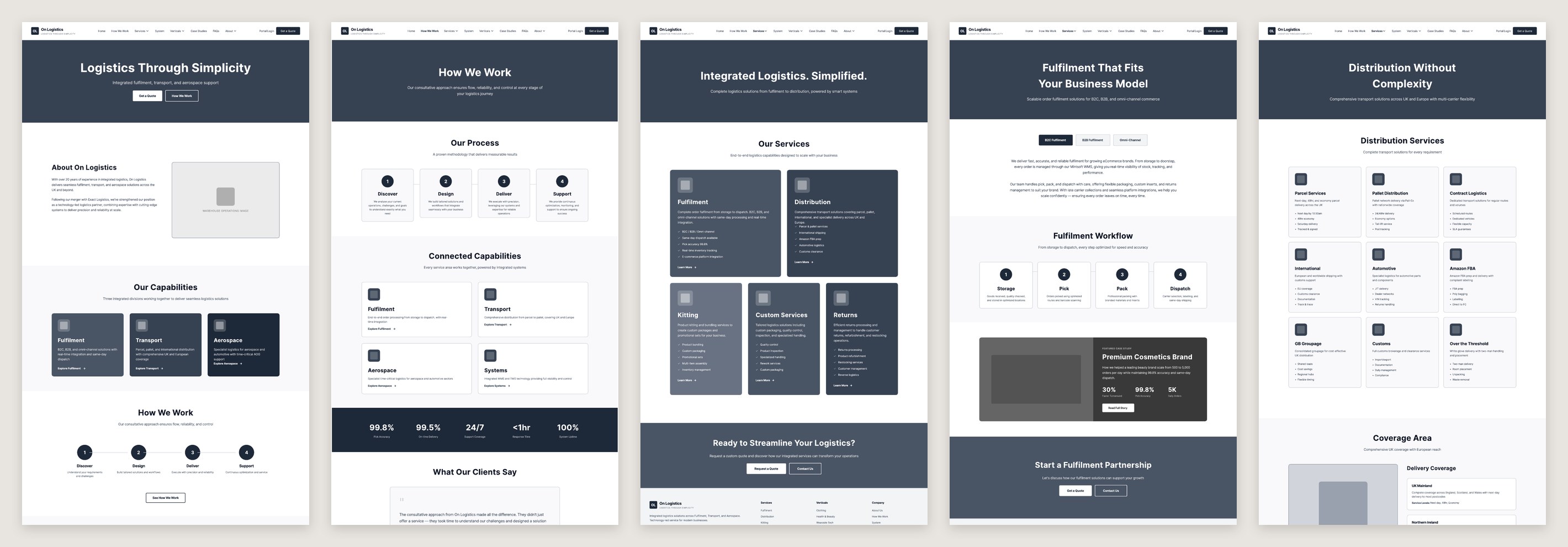 From the workOnLogisticsBrand and website design for a UK logistics company. I designed the site, WP Bees built it in WordPress.
Questions people also ask
Do I need a designer if my developer has a good eye?
On a small site, perhaps not. On a site with many page types, a designer sets the rules every page follows, so the site stays consistent as it grows.
Who should hire the designer, me or my developer?
Either works. I can be invoiced by you or by your developer, whichever suits the project.
Which platforms can a designer work with?
Any that a developer can build. I design WordPress and custom-coded sites this way, and check the developer's block list before the templates are drawn.
How much does it cost?
Pricing is bespoke. It is quoted on scope, mostly by the number of page templates, with a fixed quote within 48 hours.

Sophie is an independent designer based in the UK and the founder of S Evans Design, working across brand, web and product for founders and brand teams. Her career work includes projects for Arsenal, DreamWorks, BBC, Sky, Channel 4, Barclays and the NHS, and she is a Squarespace Circle Gold partner. More about Sophie.