If selling products is the main job, choose Shopify. If the site’s job is to win enquiries, sell a service or show your work, choose Squarespace, which will do it for less. A small shop can sit happily on Squarespace. Once you are managing stock, variants and shipping across more than a handful of products, Shopify is the better call.
What decides between Squarespace and Shopify?
What is the site’s main job?
If it is to make someone trust you enough to get in touch, book a call or buy a service, that is a Squarespace job. If it is to sell physical products, keep track of stock and get parcels out of the door, that is a Shopify job.
Most businesses already know the answer. The confusion comes from the middle: a studio that sells a few prints, a consultant with a paid download, a maker with a small range. That middle is where the rest of this article earns its keep.
How do they compare in 2026?
| Squarespace | Shopify | |
|---|---|---|
| Built for | Services, portfolios, content and small shops | Product brands and online stores |
| Entry price, billed yearly | £12 a month (Basic), £17 a month (Core) | £19 a month (Basic) |
| Fee on product sales | 2% on Basic, 0% on Core and above, plus card processing | No extra fee with Shopify Payments; online card rates from 2% + 25p on Basic |
| Using another payment provider | Card processing through your provider | Extra fee of 2% on Basic, 1% on Grow, 0.6% on Advanced |
| Stock and variants | Built in, comfortable for a small range | Built in, designed for large ranges |
| Add-ons | A curated set of extensions | A much larger app store |
| Free trial | 14 days | 3 days, then £1 a month for 3 months |
Sources: Squarespace pricing and Shopify UK pricing. Both change their plans, so check before you commit.
When is Squarespace the right choice?
- You sell a service, or your judgement, rather than a product
- Your work has to carry the page: studios, makers, photographers, practices
- You want to change a sentence or add a page yourself without learning a system
- You sell, but the range is small and fairly stable
That last one surprises people. Clara Pinto, an independent London fashion label making hand-felted, made-to-order wool pieces, sells through a Squarespace store, and the refresh kept it there. The range is edited and the brand carries the page, which is what Squarespace does well.
When is Shopify the right choice?
- You are selling more than a handful of products, or plan to
- Your products come in sizes, flavours, bundles or kits
- Shipping, stock levels and returns are a daily job, not an occasional one
- You have outgrown a marketplace listing and want the customer to be yours
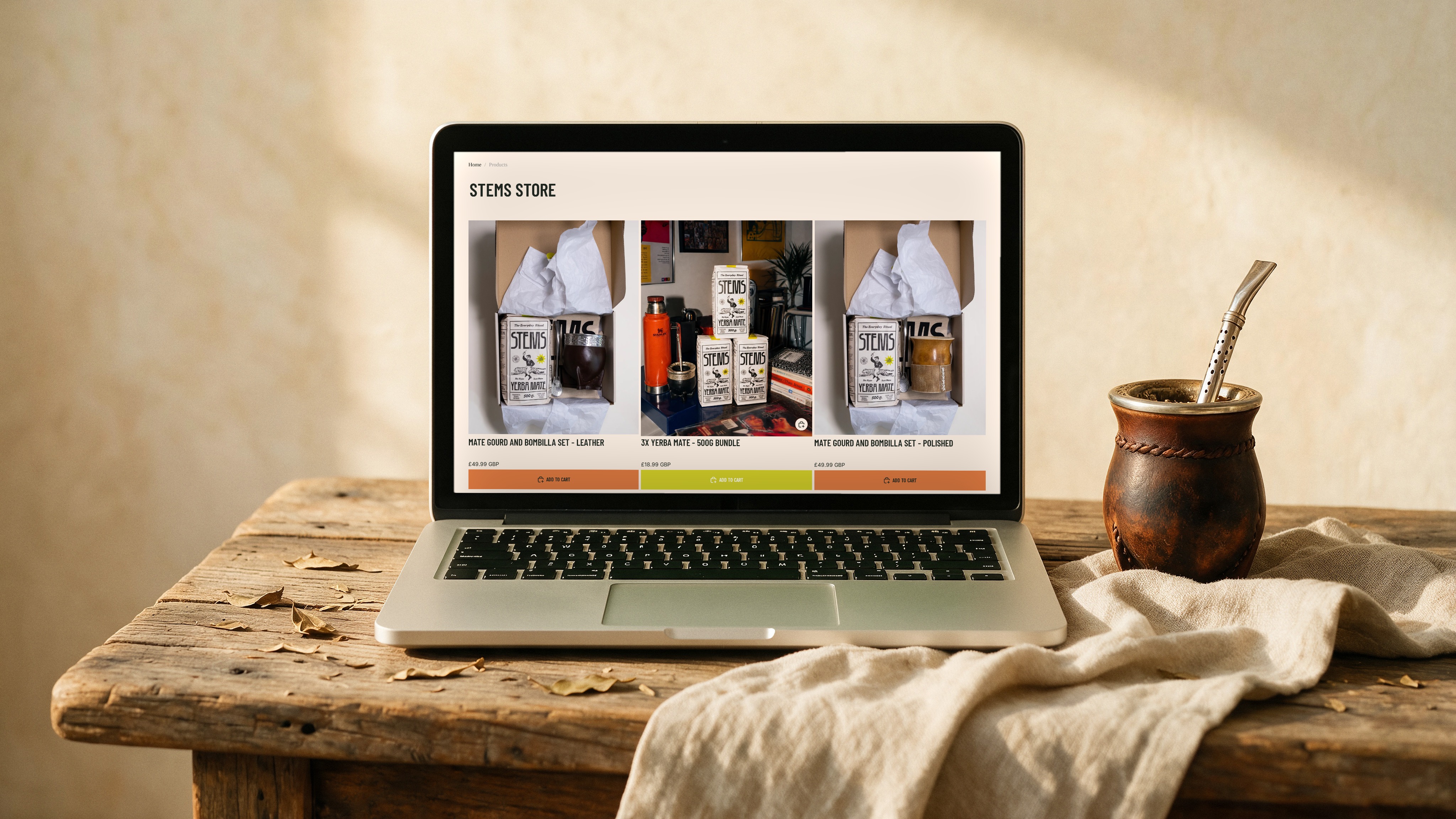
Stems, a UK yerba mate brand, sells gourds, loose leaf and starter kits. Kits and variants are exactly where Shopify earns its fee, and the store had to be simple enough for the team to run themselves once it was handed over.
Either platform can look the way you want. The decision is about the job, not the look.
Which is cheaper over a year?
On plan fees alone, billed yearly, Squarespace Core comes to £204 and Shopify Basic to £228. Shopify Grow, the next plan up, is £588. The gap at the entry level is small, so do not let it decide for you. Card fees scale with your sales on both, and the design and build will cost more than either subscription in year one.
If you want the full picture for a Squarespace build, how much a Squarespace website costs breaks down every line.
Can you switch later if you choose wrong?
It is not a life sentence. Products can be exported from Squarespace and imported into Shopify, and the reverse is possible too. What does not move is the design, so switching means rebuilding the site around your content. That is why I make the platform call with clients before anything is quoted, not after.
 From the workNuvita LabA premium Shopify store, a curated brand image library and a product render suite for a NAD+ wellness brand.
Questions people also ask
Can Squarespace handle a proper online shop?
For a small range, yes. Squarespace has stock, variants and checkout built in, and on the Core plan and above it takes no transaction fee on product sales. It starts to strain when the range grows, when you need more complex shipping or when you want the depth of Shopify’s app ecosystem.
Is Shopify harder to update yourself?
It has more moving parts, because it does more. Adding a product, changing a price or editing a page is straightforward on both. A well-built Shopify store should be one your team can add products to without calling a designer.
Which is better for SEO?
Both handle the basics: editable page titles and descriptions, clean URLs and an automatic sitemap. What ranks is the content and the structure of the site, not the platform it sits on.
Can I move from Squarespace to Shopify later?
Yes. Squarespace lets you export your products to a spreadsheet, which Shopify can import. The design does not move, so the store is rebuilt around the products. It is cheaper to make the call before the first build than after it.

Sophie is an independent designer based in the UK and the founder of S Evans Design, working across brand, web and product for founders and brand teams. Her career work includes projects for Arsenal, DreamWorks, BBC, Sky, Channel 4, Barclays and the NHS, and she is a Squarespace Circle Gold partner. More about Sophie.